Wheelchair accessible Syracuse, Sicily

Syracuse is on the South East coast of Sicily, it's a UNESCO world heritage site and is known for it's ancient Greek ruins. We had a great day in Syracuse as well as at the small island of Ortigia.
Our day didn't exactly start as planned! We didn't pre-book Sala Blu assistance and when we arrived at Catania station we found that the train was pulling into a platform which we couldn't get to as the station had no lifts.
If we had notified the station staff the previous day we wanted to use this train, they would have rearranged trains to stop at platform 1 or made arrangements so that we could roll over the train tracks. During our stay, there was only one train that morning going to Syracuse so our day looked like it had ended before it began! However the train station staff were great and so helpful, they arranged for a taxi to pick us up from Catania Train Station to take us to Syracuse (a 1 hour drive away!) at no cost to us.
For speed we didn't request a wheelchair accessible taxi and had a normal large car which I transferred into. The taxi driver was supposed to drop us off at Syracuse train station but we were cheeky and asked if they could take us to our first place we wanted to visit instead! He agreed and we were so happy he did as it gave us more time to explore!
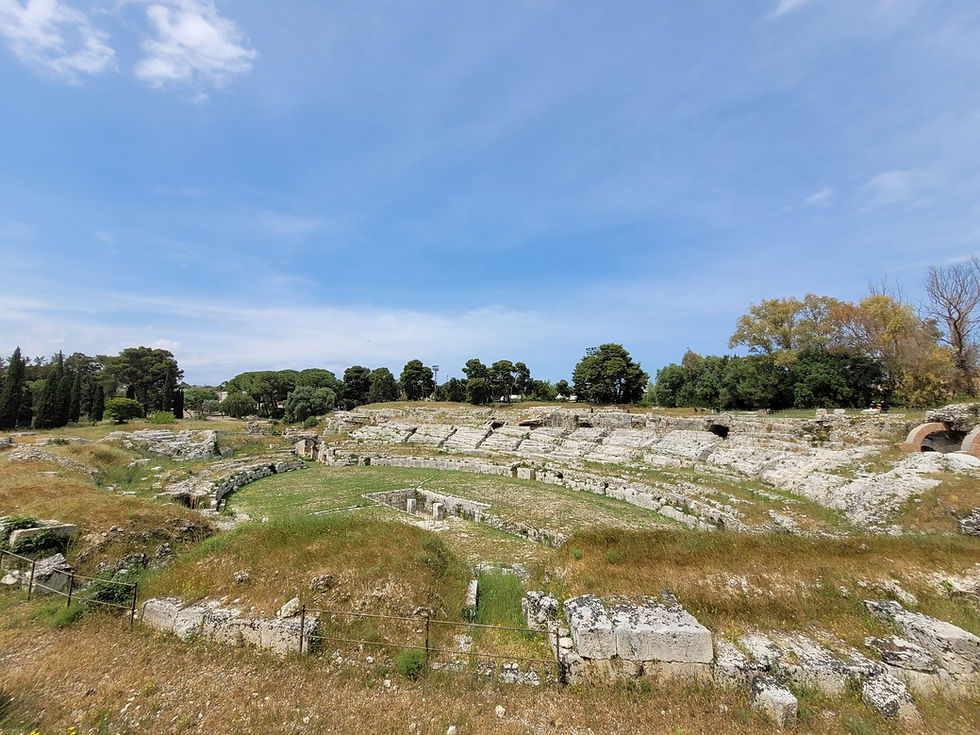
Neapolis Archaeological Park
At the heart of Syracuse's archaeological wonders is the Neapolis Archaeological Park, home to Greek and Roman ruins, dramatic stone quarries and a famous limestone cave.
The park is Syracuse's most important ancient site which dates back to the 5th century BC and was the the cultural and political heart of Greek Syracuse. The most famous structure is the Greek Theatre, one of the largest ever built. It hosted tragedies by playwrights like Aeschylus, who premiered works here nearly 2,500 years ago.

Nearby, Roman rulers later carved out an amphitheatre for gladiator games, proving how the city evolved under different empires.
Main paths throughout the park are wide and mostly level however some surfaces are uneven. Not all areas are reachable by wheelchair but the key sections can be enjoyed with planning.

Ear of Dionysius
Also inside the park you will find the 'Ear of Dionysius', one of Syracuse's most legendary sites. It is an ancient quarry carved into the limestone cliffs. According to legend, Dionysius I, a 5th-century BCE tyrant, used the cave’s extraordinary acoustics to spy on prisoners, their whispers allegedly echoed all the way to the top.
Obviously this is something we tested out too! Whether or not the legend is true, the cave’s shape does amplify sound dramatically and makes it a fascinating blend of natural geology and human storytelling.
The paths to the quarry are accessible but are uneven in places so help will be needed to get there. It's also very dark in the cave!

Ortigia
It took us about 30 minutes to roll from the park to the small island of Ortigia. It was first settled by Greek colonists from Corinth in 734 BCE, making it one of the oldest continuously inhabited places in Sicily.
Over centuries, Ortigia absorbed influences from nearly every civilization that ruled the island — Greek temples became churches, medieval palaces rose on ancient foundations, and baroque facades followed earthquakes. Today, Ortigia feels alive, not frozen in time, with everyday life unfolding among ruins and piazzas.

When we visited Ortigia it was an Italian National Holiday so it was very busy however we found the main streets, waterfront promenades and main squares to be relatively flat. As with most Italian side streets, these were narrow and cobbled but sticking to the central routes makes Ortigia one of the most wheelchair friendly historic centres in Sicily.

Fontana di Diana
The Fontana di Diana is located in Piazza Archimede and celebrates the myth of Arethusa, a nymph transformed into a spring by the goddess Diana (Artemis) to protect her from the river god Alpheus.
The fountain itself dates to the early 20th century, but the myth it depicts is far older, one of the foundational legends of Syracuse. Sculpted figures swirl dramatically around the basin, blending classical mythology with modern artistry.
This piazza is open, level and easy to navigate making it an effortless place to stop and enjoy the scene.

Fonte Aretusa
Close to the fountain lies the Fonte Aretusa, one of Syracuse’s most iconic and ancient sites. This natural freshwater spring has been flowing since antiquity and was vital to the survival of early settlers.
Ancient Greeks believed it was connected underground to the river Alpheus in Greece, a poetic idea that reinforced Syracuse’s importance in the Greek world. Today, papyrus plants grow here naturally, one of the few places in Europe where they thrive.
The location of the spring is really easy to get to with flat paths and benches.

Castello Maniace
Standing guard at the southern tip of Ortigia is Castello Maniace which was built in the 13th century by Holy Roman Emperor Frederick II who was one of the most fascinating rulers of the Middle Ages.

The castle was designed as both a royal residence and a defensive fortress, protecting Syracuse from naval attacks. Over time, it served as a military stronghold under Spanish rule and later as a prison.
The castle was a little challenging access wise but it was still possible to look round the ground level areas and appreciate the sea views.

Is Syracuse wheelchair accessible?
We had a great day in Syracuse, it's a place full of ancient history and one which can be explored easily outside. Ortigia is a really lovely island and we would definitely recommend visiting here too!
Read more about the other towns and cities in Sicily we visited on our trip here.


Comments